
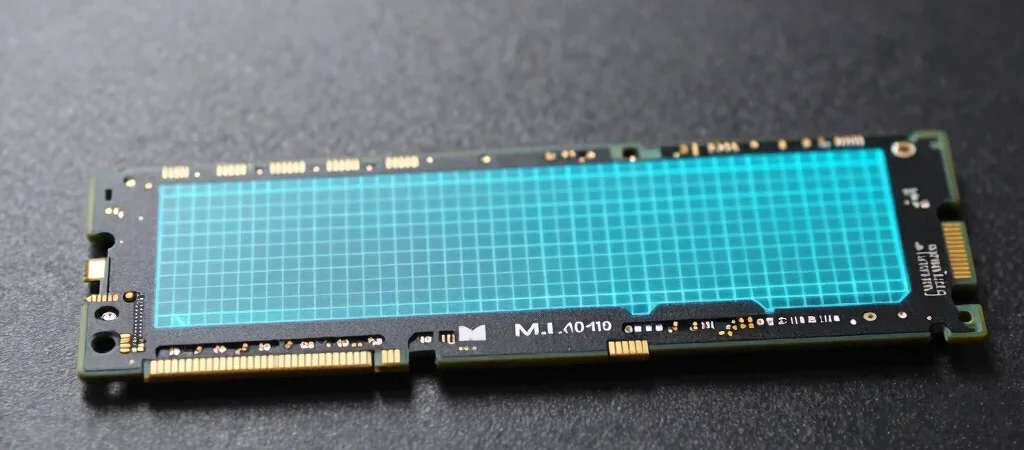
In the mid-twentieth century, storing a single gigabyte of data was an engineering feat that required physical floor space, dedicated industrial cooling, and heavy machinery. The earliest commercial hard disk drives were shipped in enclosures the size of two large refrigerators, weighing over half a ton for a fraction of the capacity of a modern email attachment.
From Washing Machines to M2 Slots
Early magnetic disk drives relied on massive platters spun by heavy electric motors, requiring air filtration systems to prevent microscopic dust from wrecking read heads. By contrast, current M.2 NVMe solid-state drives store multiple terabytes on a thin strip of silicon smaller than a stick of chewing gum, operating with zero moving parts.
The Physics of Density Scale
Shrinking storage density required mastering quantum tunneling and 3D NAND flash memory layering. Stacking memory cells vertically in over one hundred microscopic layers allowed engineers to bypass physical surface limits, achieving transfer speeds exceeding seven thousand megabytes per second across standard PCIe lanes.
What Comes After Silicon
As silicon lithography hits atomic boundaries, researchers are experimenting with optical glass storage and synthetic DNA strands for ultra-dense long-term archiving. While consumer computers will rely on flash memory for the foreseeable future, high-density archives may soon store entire server rooms inside quartz glass blocks that survive for centuries.